
HANDYMAN / BARKING
Handyman in Barking.
Make the room work.
A wardrobe that rocks, a blind that pulls away or a leaking waste can make an otherwise usable room awkward. We look at the failed connection, the material behind it and what needs to stay accessible before agreeing the repair.
Call line 24/7 · Work and availability confirmed for your address.
FURNITURE / FIXINGS / EVERYDAY REPAIRS
Can we reuse holes when mounting something in a Barking flat?
We inspect their positions, depth and condition against the new bracket and the wall construction. Holes left by a previous screen do not establish a suitable load path for a different bracket. We may need a fresh fixing arrangement or making good to redundant holes, and we agree the visible result before drilling.
Can we repair a cupboard after a small sink leak?
We first establish whether the waste, supply connection or water entering from elsewhere is responsible. Once the leak is dealt with, the cabinet needs an assessment of swelling, loss of strength and ventilation. A cosmetic patch cannot restore a crumbling base or justify enclosing damp material. We explain the furniture repair separately from the plumbing.
THE WORK IN YOUR HOME
The visible fault is our starting point.
When you contact us about a handyman job in Barking, show us the item in its surroundings as well as the damaged part. A close photograph of a pulled screw helps, but a wider view can reveal an unsupported cabinet, a tight doorway or a waste pipe behind the proposed fixing. We use both views to discuss a practical approach. We do not assume that another screw in the same hole will hold because the fitting is small.
You can combine compatible tasks in one enquiry, such as assembling storage and hanging a blind. We still consider the dependencies. Furniture may need to be positioned before its restraint is fitted; a damp cupboard needs its leak investigated before its base is repaired. Our furniture assembly, hanging and mounting, plumbing and carpentry pages explain the different kinds of work. Tell us which problems stop normal use first so we can discuss priorities rather than simply work through a list in the order it was written.
Useful details for your enquiry
- Send the furniture model or instructions, including the manufacturer’s wall-restraint requirements.
- Photograph the whole wall before marking where a screen, blind or shelf should go.
- Leave access to stop valves, waste joints, sockets and removable service panels.
- Tell us about active leaks, swollen board or a fitting that has already fallen.
- Confirm who can approve work to shared doors, rented fittings or managed-building walls.
PLAN THE WORK
Explore the time and labour budget.
Select the task, quantity and visit period. Assembly benchmarks and entered time assumptions stay visible; other repairs need an individual assessment.
Plan your Barking repair enquiry
Choose the work, enter quantities and review the assumptions. We confirm the repair, working time and availability before booking.
Assembly benchmarks assume complete product parts, instructions and a clear working area. For other repairs, a known condition does not establish a standard duration.
Compare the assembly work
Published London assembly ranges for one item. These are external planning benchmarks, not our recorded job times or guaranteed completion periods.
Time evidence: published London assembly ranges, checked 3 November 2026. Product, staffing and access differences require assessment. Carrying, missing parts and wall restraint are not automatically included.
Compare labour for the same working time
Comparison uses the selected day and visit period. These are labour categories at equal time, not fixed job prices. One-hour minimum; subsequent half hours. Materials, sourcing time, parking and congestion charges are separate. Rates include taxes. Daytime: handyman 08:00–18:00; plumbing/electrics 08:00–18:00 weekdays and 08:00–17:30 weekends. Outside-daytime availability needs confirming.
What changes the repair decision?
This compares the checks needed for the selected repair, not a scored difficulty or a promised duration.
A tall wardrobe needs more than level doors
We unpack a wardrobe against its parts list and inspect the floor where it will stand. A tall unit can appear straight from the front while its carcass leans because of a soft floor covering, a missing foot or a skirting gap. We assemble the frame square, fit the specified back and check diagonals before adjusting hinges. Door adjustment comes after the body is stable, otherwise the same uneven gap tends to return when the unit is loaded.
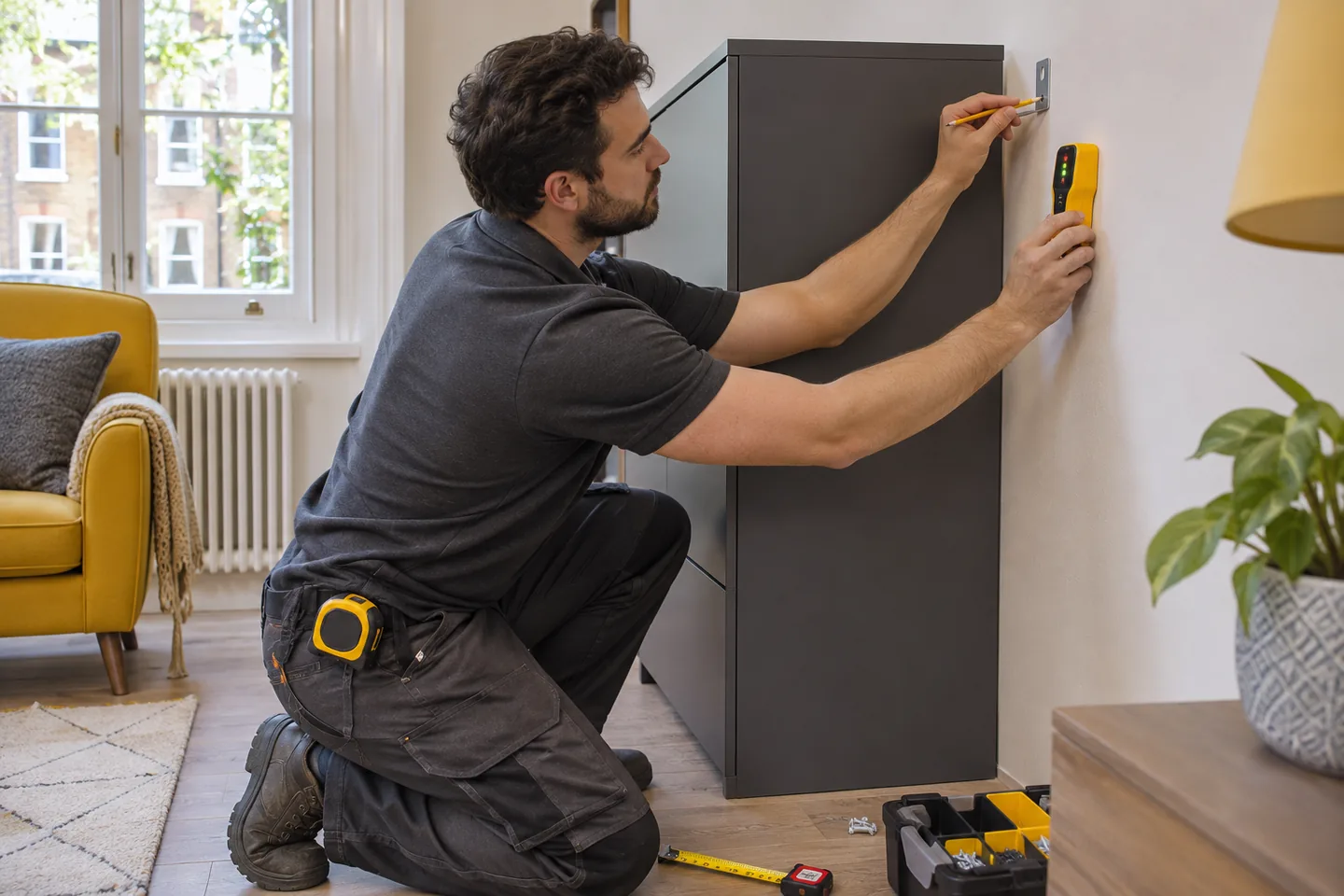
The manufacturer’s restraint is a separate part of the installation. We check the bracket arrangement, the distance to the wall and a suitable fixing point before deciding how it can be secured. A plaster finish alone is not the support. Once positioned, we test drawer and door travel, confirm that handles clear the adjacent wall and keep access to any socket behind the unit. Missing restraint hardware or unsuitable wall construction needs resolving before treating the assembly as complete.

An old television bracket leaves questions behind
Before wall mounting a television, we compare the screen’s mounting pattern and weight with the actual bracket specification. We inspect the bracket for missing spacers, distorted arms and unsuitable bolts. A previous installation is not evidence that the current combination is right. The chosen position also needs viewing clearance, access to plugs and room for the screen to move without trapping a cable or striking furniture.
We assess the wall and scan the drilling area while recognising that detection does not reveal every concealed service. Fixings must suit both the substrate and bracket loads; filling a loose hole does not turn it into a reliable fixing point. We protect the floor, control drilling dust and keep the electrical supply untouched. After fitting, we check the locking mechanism, supported movement and cable slack. If the wall cannot provide the necessary support, we discuss another location or a separate reinforcement proposal.
MATCH THE REPAIR
What changes the repair decision?
A photograph helps us start the conversation. These are the details we still need to establish at the fitting.
6 service options.
| Problem or task | What we inspect | Work to discuss | Related service |
|---|---|---|---|
| Wardrobe leans forward | Floor contact, carcass shape and restraint points | Stabilise the assembly and resolve its wall restraint | Furniture assembly ↗ |
| Screen bracket moves | Wall material, fixing holes and bracket specification | Refit only where a suitable load path is available | Hanging wall mounting ↗ |
| Water below a sink | First wet joint and condition of the cabinet | Address the leak before cabinet repairs | Plumbing ↗ |
| Blind pulls away | Reveal edge, bracket spacing and operating clearance | Choose support suited to repeated operation | Hanging wall mounting ↗ |
| Threshold lifts | Adjacent floor movement and height difference | Repair the transition or investigate the floor | Flooring ↗ |
| Utility shelf bows | Shelf span, material and intended contents | Change support or shelf specification | Carpentry services ↗ |

A tight entrance door may be an alignment issue
A door that needs lifting to latch can have loose hinge screws, a displaced strike or movement elsewhere in the frame. We watch the door open and close before removing anything. The contact marks, hinge gaps and latch position tell us more than forcing the handle repeatedly. We also establish whether the door belongs to the property or a shared entrance and whether it has fire or security functions that affect the permitted work.
For an agreed ordinary door repair, we examine the screw holding and hinge seating before changing the latch position. We do not plane an unidentified fire door or improvise around seals and closers. Where a specialist or building manager needs to decide, we explain the fault we have observed and leave the proposed alteration unmade. A final check includes operation from both sides, an unobstructed swing and a latch that engages without having to pull the door into place.

Trace sink water before replacing the cabinet floor
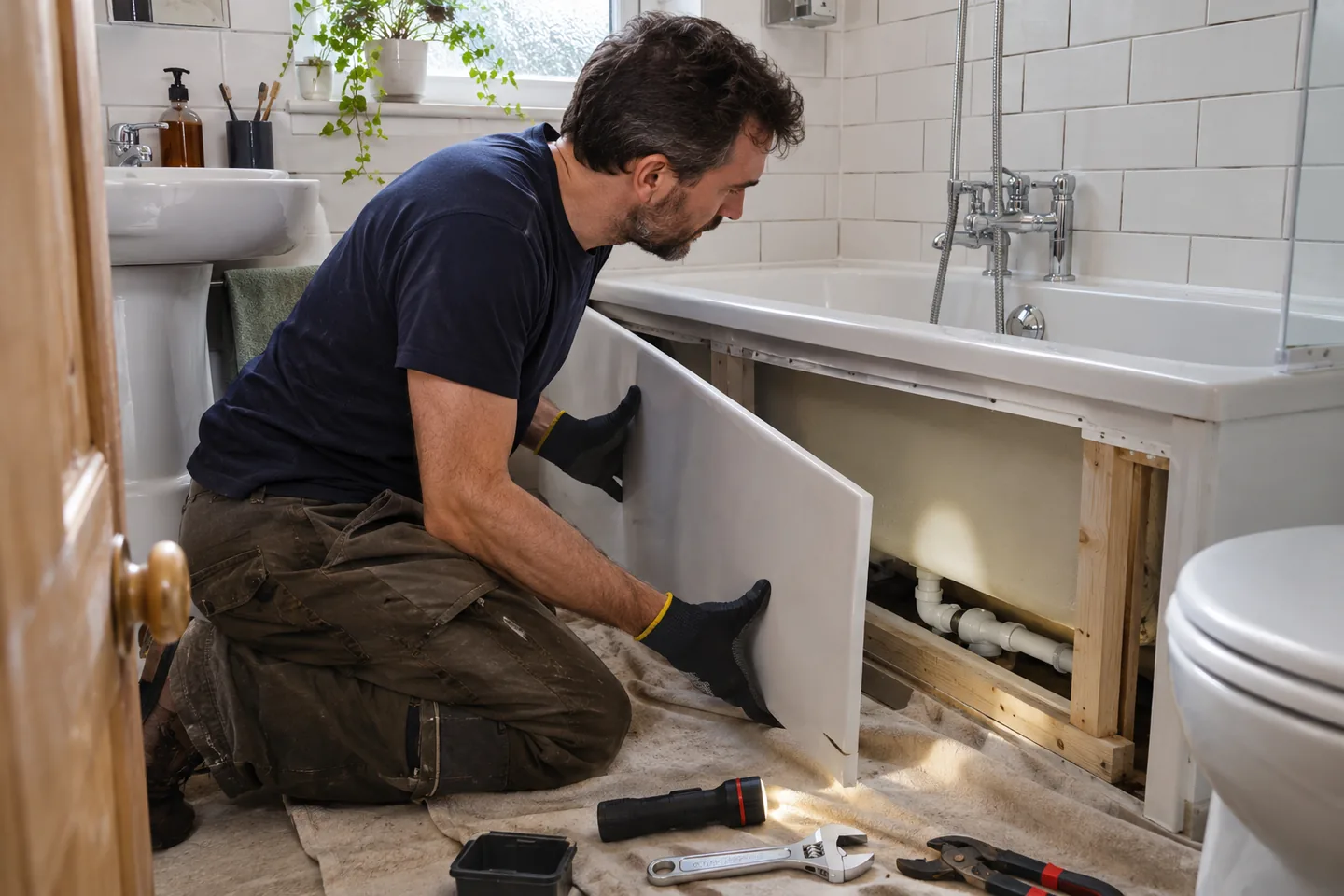
Water under a sink can travel along a hose or pipe before it drips onto the cupboard base. We clear the working area and look for the first wet joint, rather than assuming the lowest puddle marks the source. The waste arrangement, trap seals and connections need inspection under controlled use. If a supply joint is involved, we establish how it can be isolated before any dismantling. Tell us if water appears only when the basin drains or also when it is unused.
A waste repair may involve cleaning mating surfaces, replacing the appropriate seal and correcting the way the pipe sits, rather than adding sealant around an assembled joint. We then run water and examine the connections again with the cupboard accessible. Swollen chipboard requires its own decision: a weakened base may need replacing, but only once the moisture problem is understood. We keep traps and valves serviceable instead of boxing them permanently into a furniture repair.

Blind brackets must resist the pull of daily use
A blind bracket can loosen because its fixing is too close to a reveal edge or because repeated operation pulls against weak material. We check the blind’s size, bracket spacing and operating side before selecting a new position. The handle, window opening and any ventilation need clearance. A level mark alone cannot account for a deep handle that catches the fabric each time the blind is lowered.
We inspect the reveal and proposed drilling points, protect the sill and choose fixings appropriate to the supporting material. We fit the product’s safety components in accordance with its instructions and do not leave an accessible loose loop as an incidental detail. The final check uses the whole travel of the blind: it should raise, lower and sit correctly without the cassette twisting or brackets shifting. Where the reveal is unsuitable, a different fixing surface or product arrangement may be needed.

Flooring transitions should not hide a loose edge
A lifting threshold can be a damaged fixing, an incorrect profile or movement in the floor beside it. We lift only what has been agreed and inspect the adjoining edges before deciding whether a replacement strip is enough. The floor types, their heights and the required movement gap matter. Fixing through an area that needs to move can create a new problem further into the room.
We measure the transition, check the fixing route for concealed services and prepare a clean bearing surface. The chosen profile must bridge the actual change without leaving a sharp lip or preventing the door from moving. We check that screws or the specified fixing system are secure and that the adjoining floor has not been pinned incorrectly. Softness, moisture or widespread movement calls for flooring investigation rather than a longer threshold to cover the symptoms.
THE AREA / THE ACTUAL ADDRESS
Planning the work around your Barking address
Barking and Dagenham Council publishes an appraisal for the Abbey and Barking Town Centre Conservation Area. That is a reason to check an affected address and proposed alteration, rather than assume that every property in Barking has the same restrictions. If your job concerns historic joinery, an external fitting or a feature subject to consent, establish the permissions before we agree a change. Ordinary furniture assembly still needs the owner’s permission where relevant.
The useful local details for a repair are often simpler: which entrance reaches the room, whether there is a lift, where panels can be unpacked and how building access is arranged. Give us those details with the postcode. We can then discuss an appropriate working area, protection for the route and any need to keep a shared passage open. Availability and the proposed visit are confirmed for the address and the work required.
Address information: Barking and Dagenham Council: Abbey and Barking Town Centre appraisal
Utility shelves need room for the things below
In a utility cupboard, the strongest shelf position can conflict with pipework, appliance hoses or access to a valve. We start with what the shelf will hold and the equipment that needs to remain reachable. Containers of liquid are quite different from folded cloths. We measure the clear opening, examine side panels and identify a support arrangement that does not depend on a thin decorative backing.
We cut and finish the shelf material appropriate to the agreed use, position supports consistently and avoid drilling blind into a service zone. After fitting, we check the bearing at each support and the clearance for removing the shelf if maintenance is needed. We do not bridge a required access panel permanently or obstruct ventilation for the sake of gaining one more storage level. Tell us about planned equipment changes before we settle the shelf depth.
A home desk should stay square when its drawers move
Flat-pack desks rely on their backs, braces and connectors working together. We lay out the fittings, identify the correct panel orientation and build on a protected surface. Tightening the first side fully before checking the other can lock a twist into the frame. We bring the joints together as the instructions require and check the desk’s shape before fitting runners or a drawer pedestal.
Once upright, we adjust feet where supplied and check that the drawer does not pull the desk out of position. Cables need a clear route without becoming trapped between a modesty panel and the wall. We test the moving parts with the furniture in its intended location, retain useful instructions and point out any missing or damaged components. If a product panel has split around a connector, we discuss a replacement part rather than concealing the break with a fully tightened fitting.
EMERGENCY LOCKSMITH ENQUIRIES
A locking problem deserves its own assessment
If a door closes but the key will not turn, forcing it can damage the key or lock and leave the door harder to secure. We ask what happens with the door open and shut, whether the handle returns normally and whether the difficulty appeared suddenly. Those observations help distinguish a lock fault from a door that has dropped against its strike. They do not replace an inspection or establish that a new cylinder is the right answer.
We can discuss locksmith help alongside the other repairs in your Barking enquiry. Tell us whether you are locked out, unable to lock up or dealing with damage, and identify the door and the authority to work on it. A shared entrance requires the relevant approval. We do not promise a particular entry method or arrival time before assessment. Our call line is open 24/7 on 020 3746 0607, with attendance and the proposed work confirmed for the circumstances. Any change should leave the agreed locking operation checked, including the way the door meets the frame, rather than treating a working key as the only measure of the result.
BEFORE YOU BOOK
Questions about the work here.
Should we order replacement furniture fittings first?
Send the product reference and a clear photograph before buying. Hinges and runners that look similar can have different mounting positions and adjustment ranges. We can discuss whether a manufacturer-specific part is needed; we cannot confirm compatibility from appearance alone.
Can we hang a mirror above a socket?
The whole fixing route needs checking, including possible concealed cable routes. We review the mirror weight and hanging arrangement as well as the wall. A socket below is a reason for closer assessment, not a point from which to guess a safe drilling depth.
Does a small plumbing repair include repainting?
We agree the plumbing and making-good work separately. A repaired joint needs checking before the surrounding cupboard or finish is closed. Dampness and staining can require drying or further investigation before decoration is sensible.
Can we keep using a rocking wardrobe?
Avoid loading or climbing on unstable furniture and keep children away from it. Tell us whether the restraint is missing or detached. We need to assess stability and the manufacturer’s installation arrangement before advising on the repair.
Do we need to empty a room?
Usually we need a clear working area and a safe route to it, rather than an empty property. For assembly, allow room to lay panels flat and turn the unit. Remove fragile items and tell us about anything too heavy to move before the visit is arranged.
How do we start a Barking enquiry?
Call 020 3746 0607 with the postcode, a short task list and photographs if available. Include access restrictions and any parts already purchased. Our call line is open 24/7; the working arrangements and availability are confirmed for the actual job.
TELL US WHAT NEEDS ATTENTION
Discuss your Barking repair list.
Call 020 3746 0607 with the property address, the items needing attention and the available access. We review the work and confirm the arrangements before a visit is booked.
Original illustrative work scenes show the activities described; they are not photographs of completed customer jobs in this neighbourhood.