
HANDYMAN / BOW
Handyman Bow.
Put the room back in order.
After a move or a room change, small problems become obvious: a loose threshold, a catching door or storage that needs assembling. We assess each task and agree the right order of work.
Call line 24/7 · Work and availability confirmed for your address.

Room repairs that consider floors, furniture and fittings together.
Can you help after I move furniture into a Bow property?
Send a list of the assembly and repair tasks with product details and photographs. We check access, final positions and space to work. Tell us if a fitting has been damaged during the move so it is assessed before the item is reassembled or loaded.
Can you refit a floor trim that keeps coming loose?
We inspect the trim system, substrate and neighbouring flooring. Repeated loosening may indicate more than a failed screw or clip. We explain whether a compatible local repair is suitable or whether movement in the surrounding floor needs attention.
THE WORK IN YOUR HOME
Start at the floor and work through the room
Furniture and fittings depend on the surfaces around them. An uneven base can leave a cabinet leaning, a loose floor edge can catch beneath a door and a wet cupboard can damage more than one panel. For handyman work in Bow, we look at those relationships before treating the visible symptom. We explain what can be repaired locally and what needs a wider assessment.
A useful enquiry includes the room, the fault and what changed before it appeared. Tell us about a recent delivery, flooring replacement or water incident, even if you are not sure it is related. We can review assembly, wall mounting, door adjustments and accessible plumbing alongside small finishing jobs, with the parts and preparation agreed for each task.
Useful details for your enquiry
- Thresholds and floor edges assessed for movement and sound support.
- Door clearances checked before trimming or hardware changes.
- Storage and beds assembled in the right final position.
- Shelves and rails matched to the background and intended use.
- Water-related defects investigated before finishes are restored.
MATCH THE REPAIR
From a room symptom to a practical decision
Tell us what changed recently and where the fault is visible. These are examples of the checks involved.
6 service options.
| Problem or task | What we inspect | Work to discuss | Related service |
|---|---|---|---|
| Trim repeatedly lifts | Fixing system and adjoining floor movement | Repair locally or investigate wider floor | Flooring ↗ |
| Door scrapes halfway open | Hinges, floor profile and contact marks | Adjust before discussing edge removal | Carpentry services ↗ |
| Moved wardrobe will not square | Panel joints and backing condition | Use sound components and correct assembly | Furniture assembly ↗ |
| Bed has mixed fittings | Instructions and structural connections | Identify compatible parts before loading | Furniture assembly ↗ |
| Wall rail holes are enlarged | Background and mounting pattern | Establish a suitable attachment area | Hanging wall mounting ↗ |
| New paint covers damp mark | Water source and material condition | Resolve and prepare before finishing | Water damage restoration ↗ |
A lifting edge needs the floor beneath checked
We inspect where the trim has separated and identify its intended fixing system. A clip track, screw-fixed strip and proprietary transition each need their own approach. The adjoining floor heights and edges are checked for damage, along with the support underneath. We also consider whether the floor needs a movement gap that must not be trapped by the repair.
For suitable local work, the damaged attachment is prepared and a compatible trim refitted or replaced. Drilling is assessed for concealed services and material condition. We check the transition in the normal walking route and explain any difference in floor level that remains. If the surrounding floor is unstable or water damaged, our flooring service can review the wider issue rather than disguise it beneath a new strip.

Door clearance is measured through the whole swing
A door may clear at its closed position and scrape halfway open. We identify the contact marks, compare the hinge gaps and check the floor profile. Recent flooring or a rug can reduce clearance, while loose hinge screws can drop the leaf. The repair follows that diagnosis, not an automatic decision to cut the bottom edge.
Where adjustment is suitable, we support the door and restore sound hardware connections. If trimming is proposed, we discuss the construction, allowance and affected finish first. Specialist door requirements must be respected. After work, we test opening, latching and clearance with the threshold and surrounding room in place. Related frame and timber tasks are covered through our carpentry work.

A relocated wardrobe needs checking before reassembly
Furniture taken apart for a move can have damaged dowel holes, missing cam fittings or a bent backing panel. We inspect the components and compare them with the instructions before building. Repeated disassembly is not suitable for every product, and material already broken around a structural connection may need a different decision.
We plan the protected assembly area and final position, including skirting and access to the wall restraint. The carcass is checked square before doors and drawers are aligned. We follow the securing instructions and assess the wall rather than assume the supplied plugs are correct. Missing proprietary components are identified clearly. Our assembly service can review new products as well as suitable reassembly enquiries.
PLAN THE WORK
Explore the time and labour budget.
Select the task, quantity and visit period. Assembly benchmarks and entered time assumptions stay visible; other repairs need an individual assessment.
Plan your Bow repair enquiry
Choose the work, enter quantities and review the assumptions. We confirm the repair, working time and availability before booking.
Assembly benchmarks assume complete product parts, instructions and a clear working area. For other repairs, a known condition does not establish a standard duration.
Compare the assembly work
Published London assembly ranges for one item. These are external planning benchmarks, not our recorded job times or guaranteed completion periods.
Time evidence: published London assembly ranges, checked 3 November 2026. Product, staffing and access differences require assessment. Carrying, missing parts and wall restraint are not automatically included.
Compare labour for the same working time
Comparison uses the selected day and visit period. These are labour categories at equal time, not fixed job prices. One-hour minimum; subsequent half hours. Materials, sourcing time, parking and congestion charges are separate. Rates include taxes. Daytime: handyman 08:00–18:00; plumbing/electrics 08:00–18:00 weekdays and 08:00–17:30 weekends. Outside-daytime availability needs confirming.
What changes the repair decision?
This compares the checks needed for the selected repair, not a scored difficulty or a promised duration.
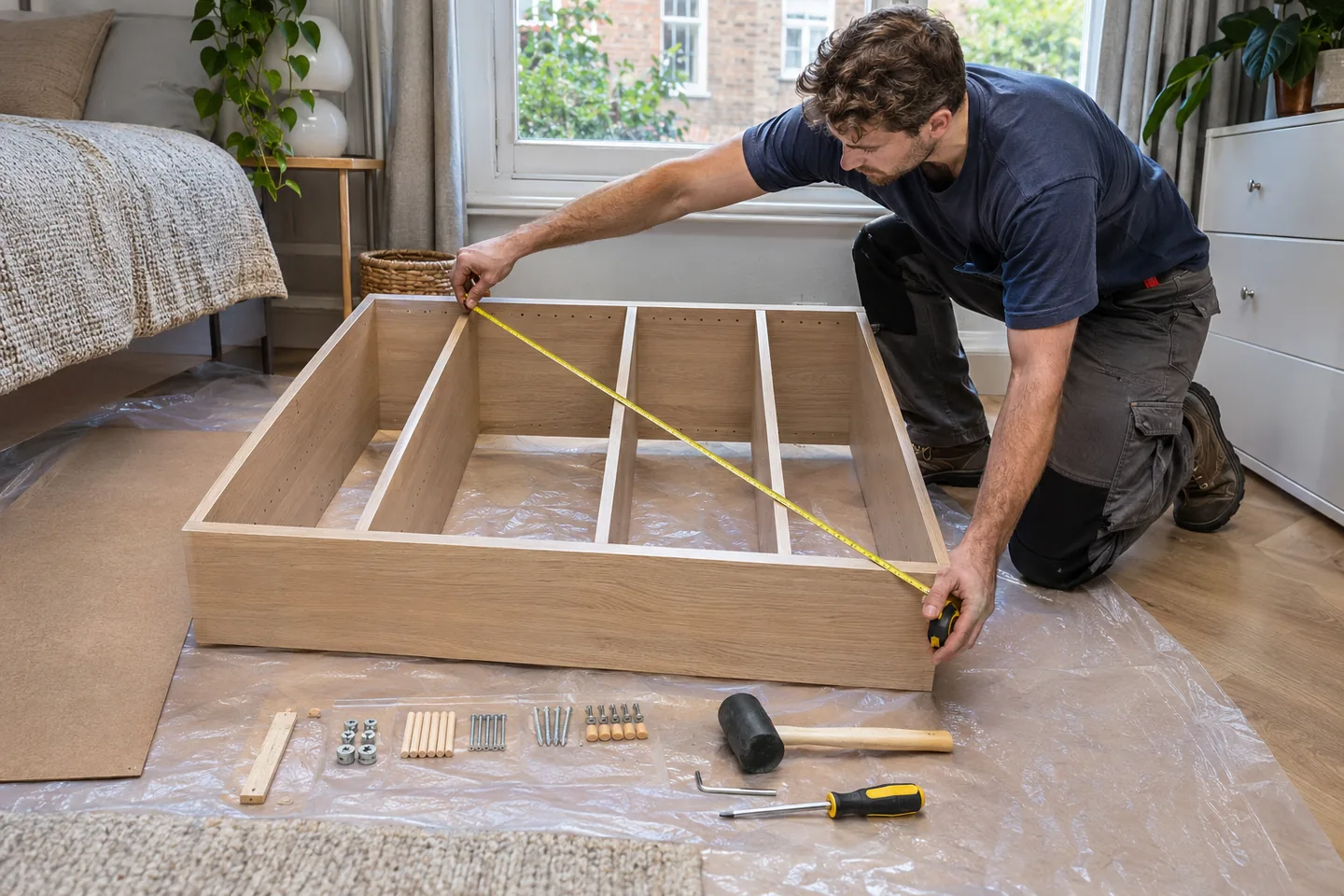
A bed should not be pulled together with the wrong bolts
Loose bags of fittings can become mixed during a move. We identify the correct fasteners and structural parts before assembling a bed, using the product information where available. Similar bolt diameters do not guarantee the same length or thread. The frame, slat supports and centre legs are checked for damage before they carry a mattress.
Assembly follows the intended sequence so joints are aligned before final tightening. We check the frame’s square and contact with the floor, and operate supplied storage features according to their instructions. A cracked rail or missing bracket is explained rather than replaced with an improvised connection. At handover, the remaining product information and unused proprietary parts stay together for future reference.
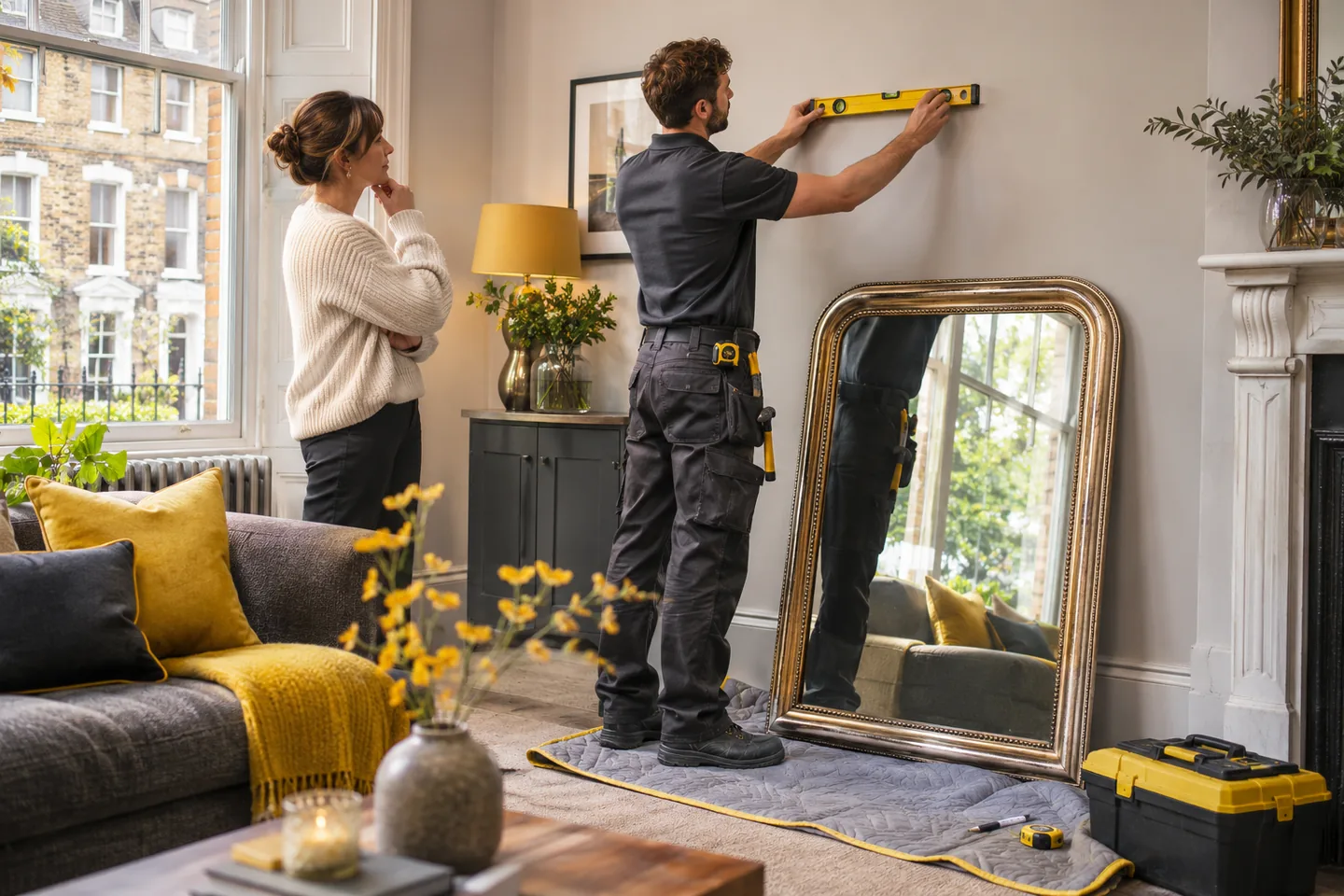
Wall hooks need sound support after old fittings come down
A previous occupier’s hook position may be convenient but unsuitable for a different rail. We inspect old holes, the new item’s mounting pattern and the background. Nearby sockets, switches and possible pipe routes inform the drilling assessment. We ask what the rail will hold and whether the position can change if the existing area is weak.
Where suitable, we mark out and select an attachment method for the actual construction. Loose plaster and enlarged holes need addressing rather than being concealed by a wider backplate. We check the finished fitting for seating and visible movement. Our hanging and mounting service also considers shelves and mirrors, with each item assessed against its own mounting requirements.
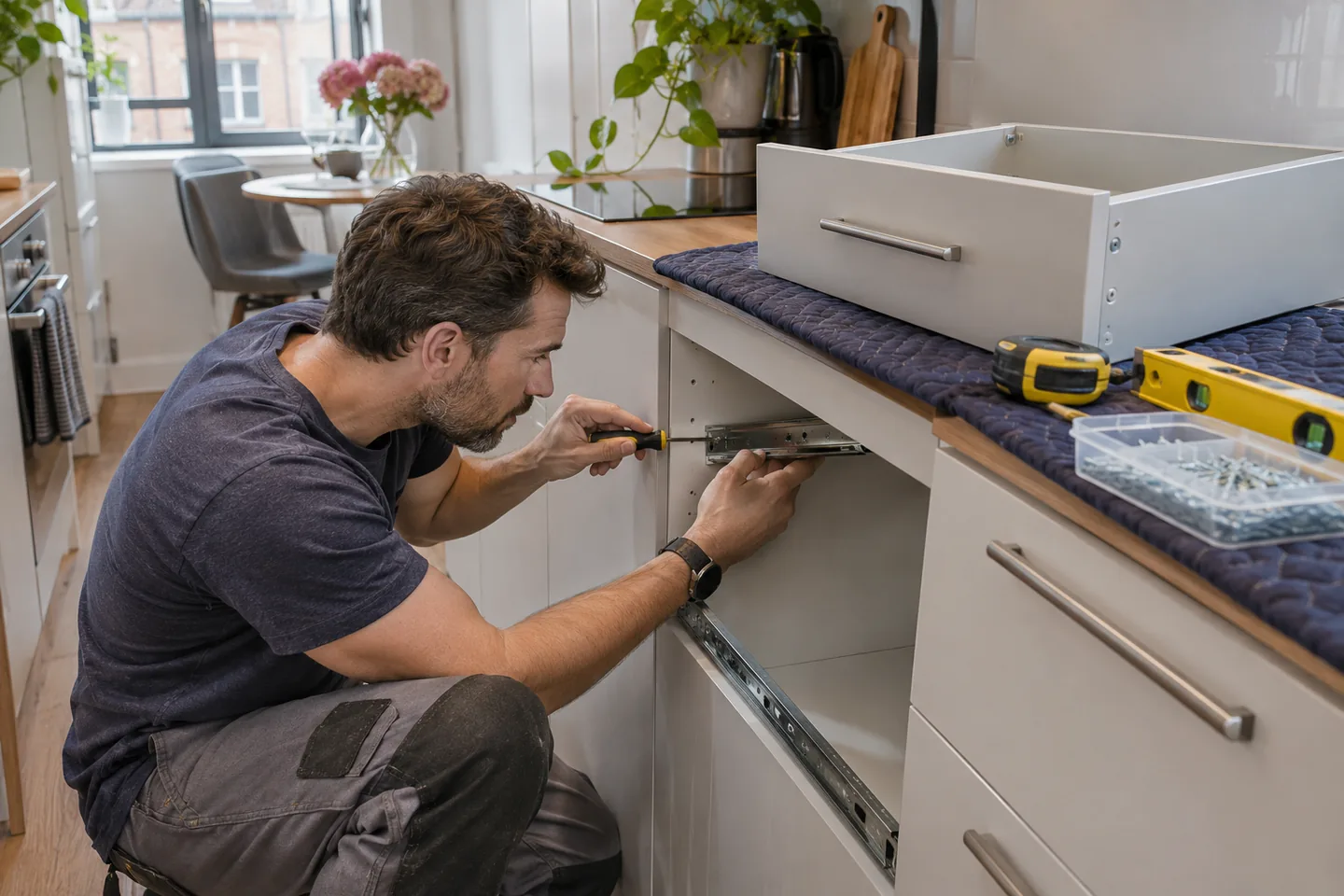
Kitchen drawers may need alignment after a move
A drawer that catches can have a shifted runner, a damaged box or an obstruction behind it. We empty and support it before removal, using its intended release method. The cabinet support and neighbouring fronts are checked as well; adjusting one runner will not correct a unit that has moved out of square.
Compatible replacement hardware is selected by dimensions and mounting arrangement. Where a local adjustment is suitable, we check stops, smooth travel and clearance to adjacent doors. Damaged board at the runner fixing may limit repair. We explain the remaining condition rather than tightening until the screw loses what grip it has. Cabinet and drawer work can be reviewed alongside other household tasks.

Water damage changes the repair sequence
A stain at the base of a unit can be old or active, but it needs investigation before new trim or paint conceals it. We ask when moisture appears and inspect accessible fittings. The source may not be the nearest visible joint, as water can track along a surface. Isolation and access are considered before any plumbing repair is agreed.
Once the source is addressed, surrounding material needs assessment for suitability. Swollen board, loose floor edges or a wet wall may require more than drying the surface. We explain the distinction between fitting repairs, replacement of damaged material and water damage restoration. That order helps avoid finishing a surface that remains affected by the original problem.
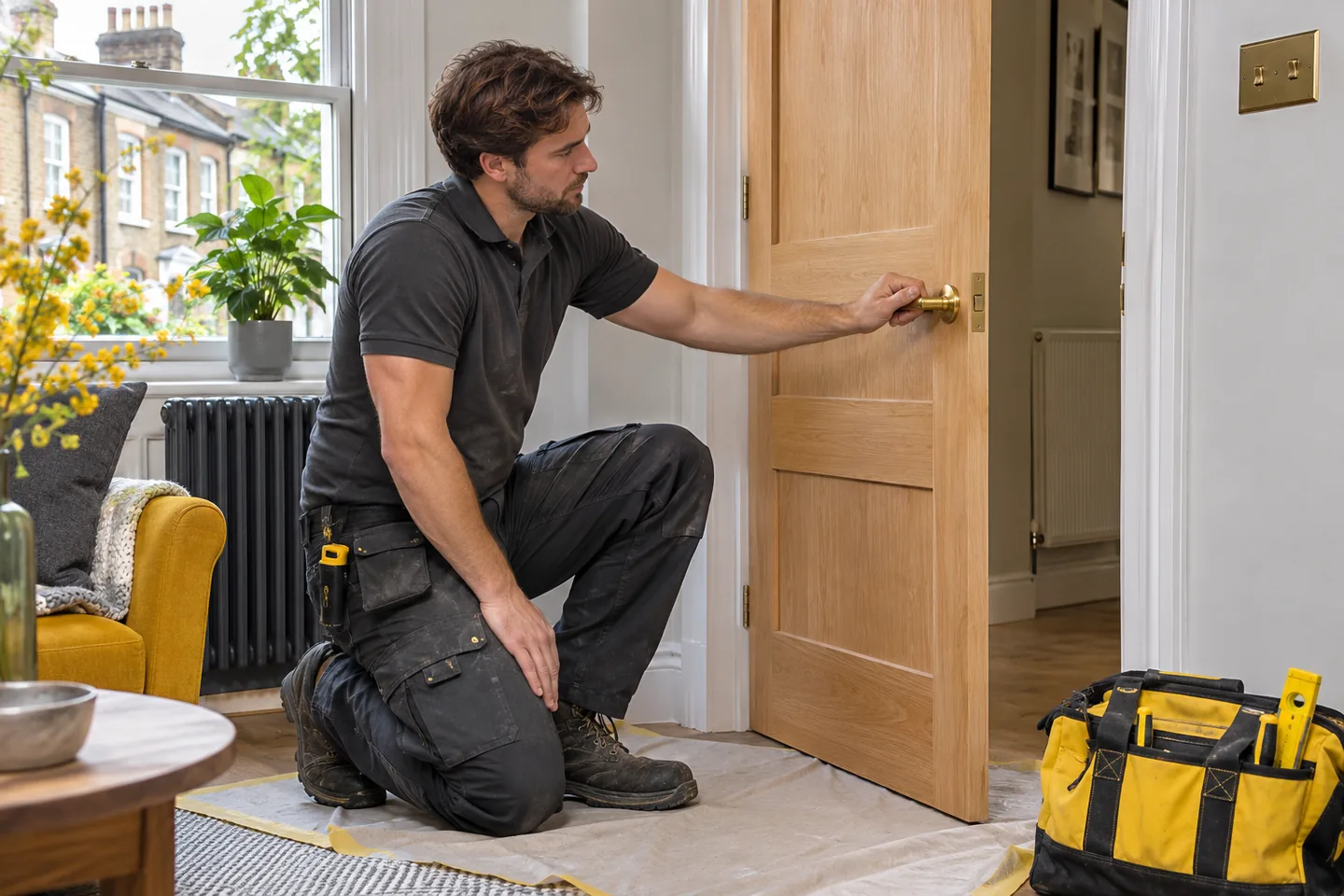
Finish the details after the movement is right
New sealant, filler and paint should follow the mechanical repair and preparation, not substitute for them. We check the condition of the joint or surface and explain the product requirements. A moving bath edge, loose trim or unresolved leak can undermine a fresh finish. Where local making good is appropriate, the surrounding area is protected and prepared before material is applied.
At the final check, we operate repaired doors and drawers, inspect the mounted items and review accessible water connections where relevant. We explain curing or loading instructions and remaining decisions. Our decorating service can address a wider finish where a small patch would remain visible. You should have a clear understanding of both the functional repair and any surface work still needed.
THE AREA / THE ACTUAL ADDRESS
Bow: identify the property beyond the local landmark
Tower Hamlets Council’s Roman Road Bow neighbourhood-planning information gives a useful official reference for the locality. The council also identifies Roman Road market among the borough’s shopping areas. Those names help describe Bow, but the full address and entrance remain necessary for arranging work. Tell us whether access is from the main frontage or another part of the building.
Share any instructions for shared corridors, deliveries and permanent fittings, including who can approve alterations. The locality does not establish the material behind a wall or the condition of a floor edge, so task photographs are still important. Nearby service information is available for Bethnal Green, Canary Wharf, Hackney and Shoreditch. For a moved-in repair list, include where components are stored and where each item is intended to finish.
Address information: Tower Hamlets Council: Roman Road Bow · Tower Hamlets Council: markets
EMERGENCY LOCKSMITH ENQUIRIES
A moving-day lock problem needs a separate description
If you discover a stiff key or an unreliable latch while moving in, tell us about it separately from the furniture list. We ask whether the door can be secured and whether the fault occurs with it open as well as closed. A door catching on new flooring can affect locking alignment, but the mechanism itself also needs appropriate assessment. Keep existing keys and any loose hardware available, and avoid forcing the key to overcome resistance.
Our call line is available 24/7 on 020 3746 0607 for locksmith enquiries. We confirm availability, proposed work and price for your address and circumstances. Give the door type, access situation and any building requirements, with photographs if safely obtainable. We may need information establishing authority to enter or change the hardware. After agreed work, we check the door and lock together in normal operation and explain any associated frame or hinge problem. Where new keys or components are supplied, keep the relevant information together and ensure authorised users understand the arrangement. A lock enquiry can be reviewed alongside the handyman list, but the security issue should not be buried among non-urgent finishing tasks.
BEFORE YOU BOOK
Questions about the work here.
Can flat-pack furniture be rebuilt after moving?
We assess the product and condition. Some panels and joints do not tolerate repeated dismantling, and proprietary parts may be missing. Send photographs of the components and damaged areas before assuming the item can be rebuilt as before.
Can a flooring edge be glued down?
That depends on the flooring system, substrate and movement requirements. An unsuitable adhesive can create another problem or prevent necessary movement. We identify the construction and explain the appropriate repair rather than apply glue by default.
Should I buy a new threshold first?
Send measurements and photographs before buying where possible. The height difference, floor types and fixing system affect selection. A visually similar strip may not suit the junction or available support.
Can you fit a shelf using holes left by another shelf?
We inspect them first. The old holes may be damaged or unsuitable for the new bracket pattern. The wall and intended contents need assessment even if something previously occupied the same position.
Can assembly and decorating be combined?
We can review both, but the sequence depends on preparation, drying and access. Describe the finish you want as well as the furniture. It may be practical to complete surface work before final placement or wall securing.
How should I describe a mixed repair list?
Use a room-by-room list with one symptom per item, photographs and product details where relevant. Identify urgent security or water issues separately, and tell us who can approve parts or additional work.
TELL US WHAT NEEDS ATTENTION
Discuss your Bow repair list.
Call 020 3746 0607 with the property address, the items needing attention and the available access. We review the work and confirm the arrangements before a visit is booked.
Original illustrative work scenes show the activities described; they are not photographs of completed customer jobs in this neighbourhood.