
HANDYMAN / STREATHAM
Handyman Streatham.
Make the room
work better.
We deal with the repairs that interrupt an otherwise usable room: the dragging door, the loose rail and the storage that will not close. We examine the cause and agree the practical work.
Call line 24/7 · Work and availability confirmed for your address.

Measure the clearance. Repair the connection.
Can you work on a bedroom without clearing the whole home?
We discuss the working area required for the individual task. A hinge adjustment and a bed assembly need different space. Tell us what remains in the room so we can agree what should move, how nearby surfaces will be protected and whether the proposed arrangement is practical.
Do Streatham conservation restrictions affect every repair?
The property’s actual designation and the proposed alteration matter. Lambeth publishes separate conservation guidance for named areas, including Streatham Common. Tell us about any known listing or restriction; we do not assume the whole neighbourhood has one status or that every interior task needs consent.
THE WORK IN YOUR HOME
Start with what prevents you using the room.
A maintenance list often grows around one room. The bedroom door catches the carpet, drawers run unevenly and a curtain fitting has loosened above the window. We ask how each problem affects the room before discussing the order of work. Several tasks may share preparation, but their materials and fixing requirements still need individual attention. We use the enquiry to identify those differences rather than assign every small repair the same allowance.
We take Streatham enquiries for fitting, assembly and practical property repairs, with related trades discussed where necessary. Send views that show the whole item and its surroundings. We want to understand the clearance beside the bed, the surface behind the bracket and the furniture standing beneath the proposed work. Those details help us plan the visit and explain any condition that needs inspection before a repair can be agreed.
Useful details for your enquiry
- Which room is affected and what no longer works properly.
- Where a moving part catches or a connection loosens.
- The exact model of furniture or fittings already purchased.
- Space available for panels, tools and moving components.
- Access arrangements and who may approve changes.
Bed frames: check the supports that disappear beneath the mattress.
We need the bed model, instructions and details of any existing damage. For a new frame, keep the packs together and identify the final position before assembly. The room must allow the rails and panels to be laid out and connected without striking nearby furniture. Tell us if an old bed remains in place or if heavy packages still need carrying; those arrangements require discussion.
We assemble the connections in the order specified, fit the centre supports and slats as intended and check the frame before it is put into use. A missing bracket or damaged rail cannot be corrected by simply tightening every screw. We explain incomplete components and any floor condition affecting support. Moving parts on storage beds need their own product-specific checks rather than being treated as ordinary fixed rails.
MATCH THE REPAIR
What is affecting the room?
Use these distinctions when preparing your list. Product details and the condition at the property determine the final arrangement.
6 service options.
| Problem or task | What we inspect | Work to discuss | Related service |
|---|---|---|---|
| Bed frame needs assembly | Model, supports and working space | Follow the product and check connections | Furniture assembly ↗ |
| Door drags on the floor | Hinges, clearances and recent changes | Establish cause before alteration | Carpentry services ↗ |
| Drawer front sits unevenly | Frame, runners and attachment points | Repair support before adjustment | Carpentry services ↗ |
| Curtain bracket loosens | Surround, holes and product | Assess fixing position and background | Hanging wall mounting ↗ |
| Handle keeps moving | Connector and surrounding material | Use a compatible repair or replacement | Odd jobs ↗ |
| Bathroom joint fails again | Movement, moisture and preparation | Resolve the background before resealing | Tiling grouting re sealing ↗ |

A bedroom door should clear its surroundings without needless alteration.
We look at the door in motion, including its relationship to carpet, thresholds and furniture. A rubbing edge can follow a flooring change, but it can also result from a loose hinge or a frame problem. We check the accessible attachment and clearances before suggesting removal of material. If the door has a fire-safety function, that requirement must be understood before adjustment.
For agreed work, we support the door as necessary and protect the immediate area. Compatible hardware, a sound fixing and correct alignment are considered together. We check opening, closing and latch engagement after the repair. Any newly exposed edge or disturbance to the painted finish is discussed as part of the handover, so the practical adjustment and the remaining decoration are both clear.
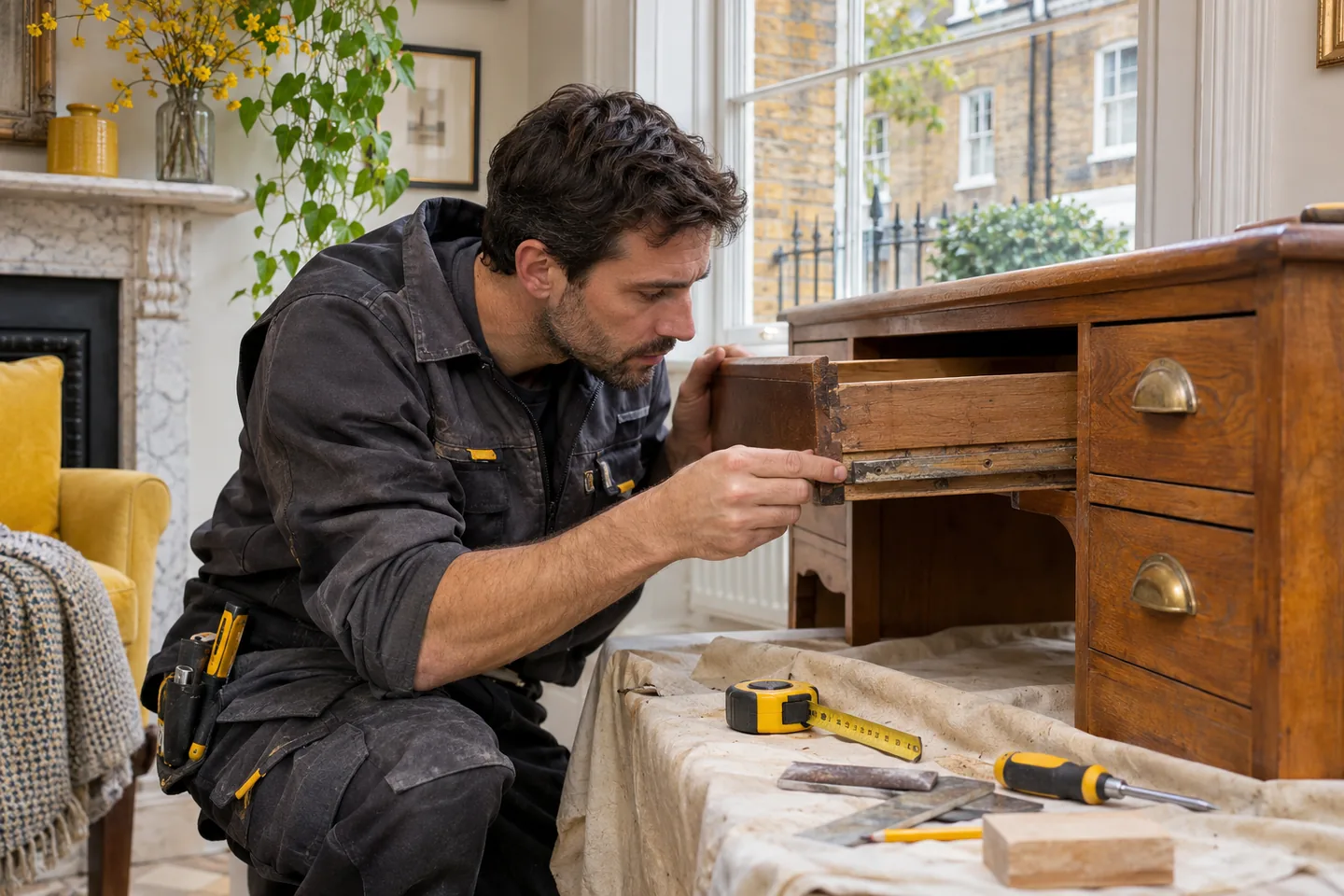
Drawer problems can begin outside the drawer itself.
Before changing runners, we examine how the cabinet stands and whether its frame is square. An uneven base, loose back or damaged joint can change the opening around a drawer. We remove accessible components carefully and keep their fittings identified. A close photograph of a broken runner helps, but the surrounding cabinet view often explains more about the cause.
We use the adjustment intended for the actual runner system and inspect attachment points in the board or timber. Product-specific components may need replacing through the supplier. Once the connection is repaired, we check the drawer through its travel and review stops, front alignment and clearance. Where the material has broken down, we explain why a new runner alone may not provide a workable repair.

Curtain fittings need an assessed background above the window.
Tell us the pole or track dimensions, curtain type and proposed position. The window surround may contain a different construction from the adjacent wall. We review the available fixing area, nearby openings and product instructions before marking the brackets. Old loose holes, surface damage or uncertain service routes can change the position or require preparation first.
We set out bracket spacing with measuring tools and check the line before drilling. Fixings need to suit the assessed support and the particular fitting. After installation, we review the operating movement and clearance for the fabric. We also discuss the condition of old fixing holes outside the agreed work: fitting a new pole does not automatically include making good and decorating the full window wall.
THE AREA / THE ACTUAL ADDRESS
A Streatham address needs its own property check.
Lambeth identifies Streatham Common as a conservation area with the common and surrounding buildings forming its setting. That is useful context when a repair touches an existing external feature, but it cannot establish the status of another property elsewhere in Streatham. We ask for the actual address, the part to be altered and any information about permissions before proposing a change.
For interior work, practical access remains just as specific. Let us know the entrance, floor and route to the room, including any restrictions affecting tools or flat-pack panels. If the home is rented or managed, identify who can approve drilling or replacement fittings. We use local guidance to frame the right questions, while the work, materials and availability are confirmed for the individual enquiry.
Address information: Lambeth Council: Streatham Common conservation area
PLAN THE WORK
Explore the time and labour budget.
Select the task, quantity and visit period. Assembly benchmarks and entered time assumptions stay visible; other repairs need an individual assessment.
Plan your Streatham repair enquiry
Choose the work, enter quantities and review the assumptions. We confirm the repair, working time and availability before booking.
Assembly benchmarks assume complete product parts, instructions and a clear working area. For other repairs, a known condition does not establish a standard duration.
Compare the assembly work
Published London assembly ranges for one item. These are external planning benchmarks, not our recorded job times or guaranteed completion periods.
Time evidence: published London assembly ranges, checked 3 November 2026. Product, staffing and access differences require assessment. Carrying, missing parts and wall restraint are not automatically included.
Compare labour for the same working time
Comparison uses the selected day and visit period. These are labour categories at equal time, not fixed job prices. One-hour minimum; subsequent half hours. Materials, sourcing time, parking and congestion charges are separate. Rates include taxes. Daytime: handyman 08:00–18:00; plumbing/electrics 08:00–18:00 weekdays and 08:00–17:30 weekends. Outside-daytime availability needs confirming.
What changes the repair decision?
This compares the checks needed for the selected repair, not a scored difficulty or a promised duration.

Wall storage: its intended contents belong in the enquiry.
A shallow display shelf and a shelf carrying books present different requirements. We ask about the product, dimensions, supports and intended use, then assess the wall where it will be fixed. Neither the item packaging nor the length of the shelf proves what the wall can support. Known services and previous repairs should be mentioned before the appointment.
We agree a practical position and compatible fixing arrangement, using appropriate detection and preparation for the accessible background. Where uncertainty remains, we explain it before drilling. We check alignment and the connections after fitting and discuss any restriction affecting use. If the background needs local repair, that work must be agreed rather than concealed behind a wider bracket or another screw.

Loose handles deserve a look at the material beneath the plate.
We examine a handle, knob or pull with the way it is used in mind. A fitting can loosen because its connector has worn, because the hole has enlarged or because the surrounding panel is damaged. We compare replacement dimensions with the existing arrangement before making new holes. Keep any original parts available, including small screws or backing pieces that have fallen away.
Where the material can accept an appropriate repair, we agree it before refitting compatible hardware. We use suitable hand tools and check movement without excessive force. For door handles, the latch and closing action are reviewed together; for cupboard pulls, clearance from neighbouring fronts matters. We explain any visible change where a new plate does not cover an old mark or fixing pattern.

Bathroom edges need more investigation than a fresh bead.
We look at the failed seal and ask whether the adjacent fitting moves or moisture returns after cleaning. Sealant renewal depends on preparing a stable joint, not covering the existing material. We discuss removal, the condition beneath it and any separate plumbing or surface work that needs attention first. Photographs should include the whole corner or edge, not only the stained patch.
We remove old material carefully where renewal is appropriate, clean the accessible surfaces and follow the selected sanitary product’s preparation requirements. We shape and check the replacement edge and explain the curing conditions before the bath or shower is used again. A labour estimate concerns the work performed; it does not establish the drying or curing period for every product.

A combined list needs clear decisions at the end as well as the start.
We check each agreed repair against its original problem and discuss any outstanding task. That might be a missing furniture fitting, a wall needing preparation or a replacement component that requires ordering. We do not describe the whole list as finished simply because the accessible adjustments have been made. The person responsible for the property needs to know which items can be used and which remain restricted.
We explain care requirements and identify any decoration or larger waste arrangement that sits outside the immediate work. For occupied rooms, we agree how the working area will be left and where loose parts belong. If the list reveals broader damage, we can discuss property maintenance or refurbishment with the repairs and their dependencies recorded individually.
EMERGENCY LOCKSMITH ENQUIRIES
Tell us whether the lock or the door is causing the difficulty.
We take Streatham locksmith enquiries through our call line 24/7. Describe whether the key is lost, the cylinder will not turn or the door has become difficult to close. The full address, door material and visible lock details help us review the enquiry. We confirm availability and the price basis for the proposed work before an arrangement is accepted; the call line does not promise an arrival period.
Where the key operates with the door open but struggles when it is closed, the relationship between the door and keep can be relevant. Where the key or cylinder is damaged, a different repair may be needed. We discuss those observations without asking you to dismantle security hardware. Tell us if the door forms part of a managed entrance or has fire-safety requirements.
We identify the person who can approve access or replacement work and review compatible components after assessment. A new lock must suit the door and intended arrangement, not only resemble the visible part. Any necessary carpentry or making-good is explained separately. We check operation following agreed work and tell you about remaining limitations, including any additional component or specialist requirement that needs attention.
BEFORE YOU BOOK
Questions about the work here.
Can you assemble a bed in a partly furnished room?
We review the model and available working space first. The final bed footprint does not show the clearance needed while parts are being connected. Send the room arrangement and tell us what can move before the visit.
Does a catching door always need shortening?
No. We check the hinges, frame and surrounding finishes before proposing adjustment. Loose support or changed alignment may be the cause. Any specialist performance requirement applying to the door must also be considered before material is removed.
Should I remove the broken drawer before you arrive?
Tell us its condition and send photographs first. Keep loose fittings together, but do not force a stuck mechanism or dismantle something you cannot support. We discuss access and the product-specific repair arrangement during the enquiry.
Can you reuse my curtain-pole screws?
We assess the supplied hardware against the wall and fitting. The screws may be useful, but their presence does not show that they suit the actual background. Existing damage and bracket positions can affect the decision.
How do we check whether the property has conservation restrictions?
Use Lambeth’s published conservation guidance and the map for the specific address. Tell us what you already know about the building and the planned alteration. A local area name alone is insufficient to decide which permissions apply.
Can all these tasks use the same labour estimate?
A combined visit still needs the actual tasks assessed. Assembly benchmarks describe stated products, while a damaged fixing needs its condition understood. We discuss the working time and any additional cost before an arrangement is agreed.
TELL US WHAT NEEDS ATTENTION
Discuss your Streatham repair list.
Call 020 3746 0607 with the property address, the items needing attention and the available access. We review the work and confirm the arrangements before a visit is booked.
Original illustrative work scenes show the activities described; they are not photographs of completed customer jobs in this neighbourhood.